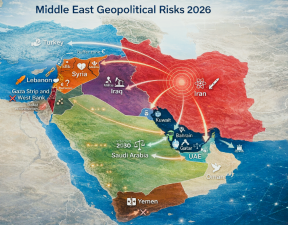
Conflict patterns vary significantly across regions due to factors such as geopolitics, historical background, economic structure, nuclear power, and external intervention. The nature of geopolitics requires us to view humanity as a whole, not as isolated individuals. This wholeness manifests at the levels of nations, political parties, ethnicities, and even beliefs. Significant differences exist between these different groups, and these differences often easily trigger conflict. At the same time, geopolitics emphasizes that we must abandon existing cultural, institutional, legal, and even violent rules, placing various groups within a complex jungle. Within this jungle, military hegemony, international institutional systems, and basic consensus on rights may exist, but these lack stability, especially compared to nations; they appear more like an unnatural state.
Differences in Conflict Backgrounds
Conflicts in different regions often have their own unique backgrounds. The Middle East has long been plagued by conflict, with religious tensions being a significant factor. Judaism, Christianity, and Islam all consider Jerusalem a holy city, and this overlap in religious beliefs makes religious conflicts in the region complex and intertwined. For example, religious factors have been a constant presence in the conflict between Israel and Palestine. Israel is predominantly Jewish, while Palestine is predominantly Muslim, leading to significant disagreements on issues such as the ownership of holy sites and religious rituals.
In contrast, conflicts in some parts of Africa stem more from tribal disputes and resource competition. In some African countries, different tribes have their own interests and spheres of influence. When resources, such as land and water, become scarce, conflict easily erupts between tribes. For example, the conflict in Darfur, Sudan, arose from a struggle between local Arab and African tribes over limited land and water resources.
Conflicts in European history are often related to territorial disputes and nationalism. Before World War I, tensions between Austria-Hungary and Serbia escalated. Austria-Hungary feared that Serbian nationalism would threaten the stability of its multi-ethnic state, while Serbia, eager to expand its territory and influence, experienced a surge in nationalism, ultimately leading to the Sarajevo assassination and igniting World War I.

Similarities and Differences in Conflict Forms
In terms of conflict forms, different regions share similarities but also have their own unique characteristics. War is a common form of regional conflict. The Middle East has experienced numerous large-scale wars, such as the five Arab-Israeli wars. These wars involved multiple countries, causing significant casualties and property damage. The forms of warfare included large-scale ground operations and air strikes. In these wars, various parties vied for territory, resources, and strategic locations.
Conflicts in Africa also frequently manifest as armed conflict, but their forms can be more complex. Some conflicts exhibit characteristics of guerrilla warfare, such as the conflict in Somalia, where different armed factions fought in mountainous areas and towns, leading to prolonged instability.
Conflicts in European history also took the form of warfare, such as the Napoleonic Wars that swept across the continent. However, European conflicts have also been resolved through diplomatic means. For example, after World War II, European countries gradually moved towards unity by establishing a series of international organizations, such as the European Coal and Steel Community, using peaceful cooperation to prevent the recurrence of conflict.
The commonality among conflicts in different regions lies in their causing casualties and property damage, and disrupting local social stability and economic development. The differences lie in the scale of the conflicts, the participating entities, and the specific methods of warfare.
The Influence of External Forces
External forces often play a significant role in regional conflicts. The Middle East, due to its crucial geopolitical position and abundant oil resources, has always been a focal point for major powers. The United States has long held significant influence in the region, supporting Israel and conducting military operations in Iraq and Afghanistan. US involvement has further complicated conflicts in the Middle East, driven by considerations such as oil interests and geopolitical balance.
In Africa, some Western countries also intervene in conflicts for their own interests. For example, in civil wars in some African countries, Western countries may support one side, providing weapons and funding, perhaps with the aim of acquiring resources or expanding their own political influence in Africa.